Intro
There are watches that tell the time, and then there are watches that tell a story about time itself.
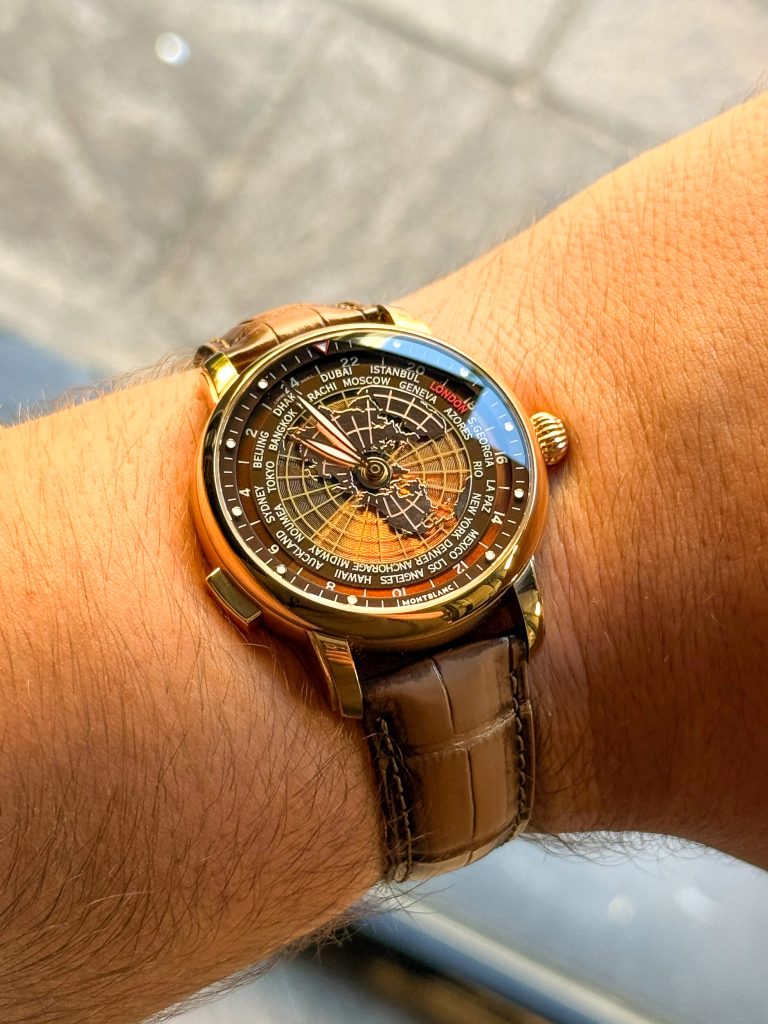
The Montblanc Star Legacy Orbis Terrarium Limited Edition – 500 pieces belongs firmly to the latter category. Created as a sophisticated expression of Montblanc’s watchmaking heritage, the Orbis Terrarium combines a world-time complication with an intricate representation of the Northern Hemisphere, all framed by a substantial case crafted entirely from 18-karat rose gold.
Limited to just 500 examples worldwide, reference MB126109 is an unusual combination of mechanical functionality, travel-inspired design and precious-metal luxury.
Its name provides the first clue to its character. Orbis Terrarium is Latin for “globe,” “earth” or “world” — an appropriate name for a watch designed to place the world’s 24 time zones directly on the wrist.
The World, Seen From the Wrist
The Orbis Terrarium’s defining feature is its dial.
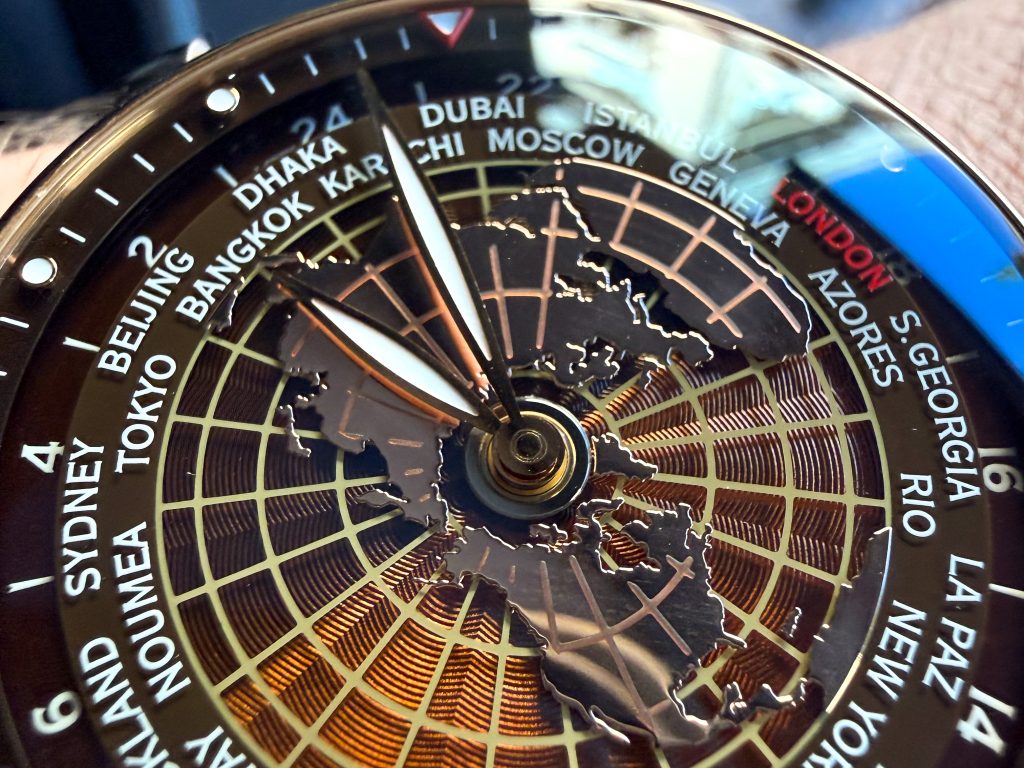
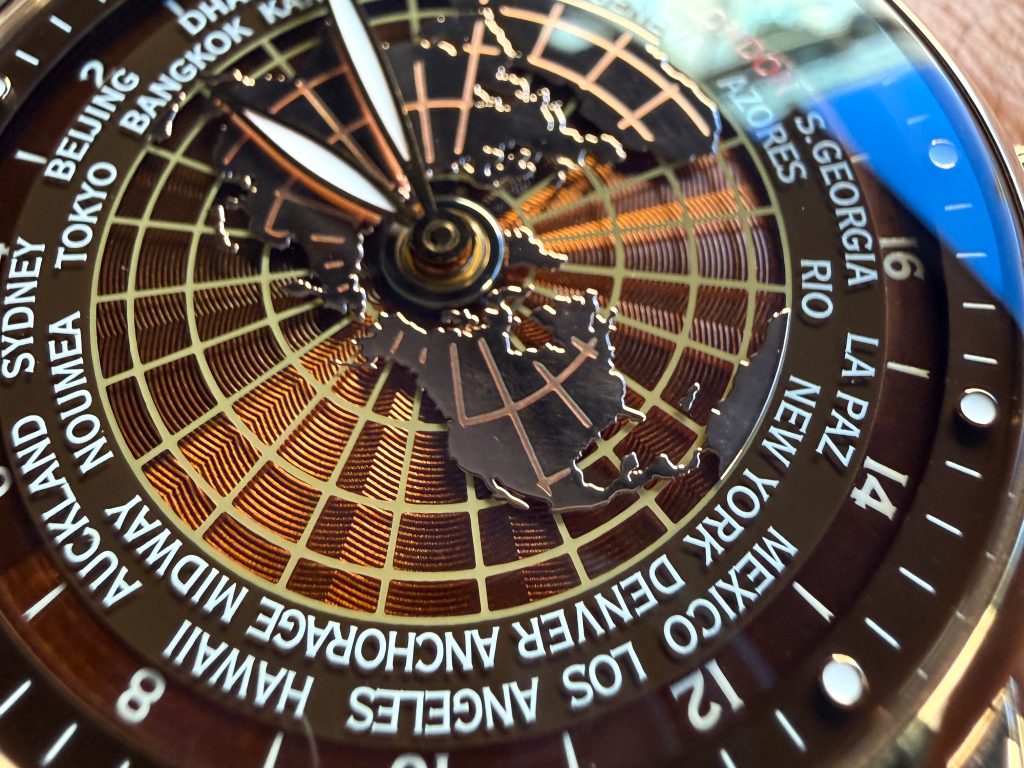
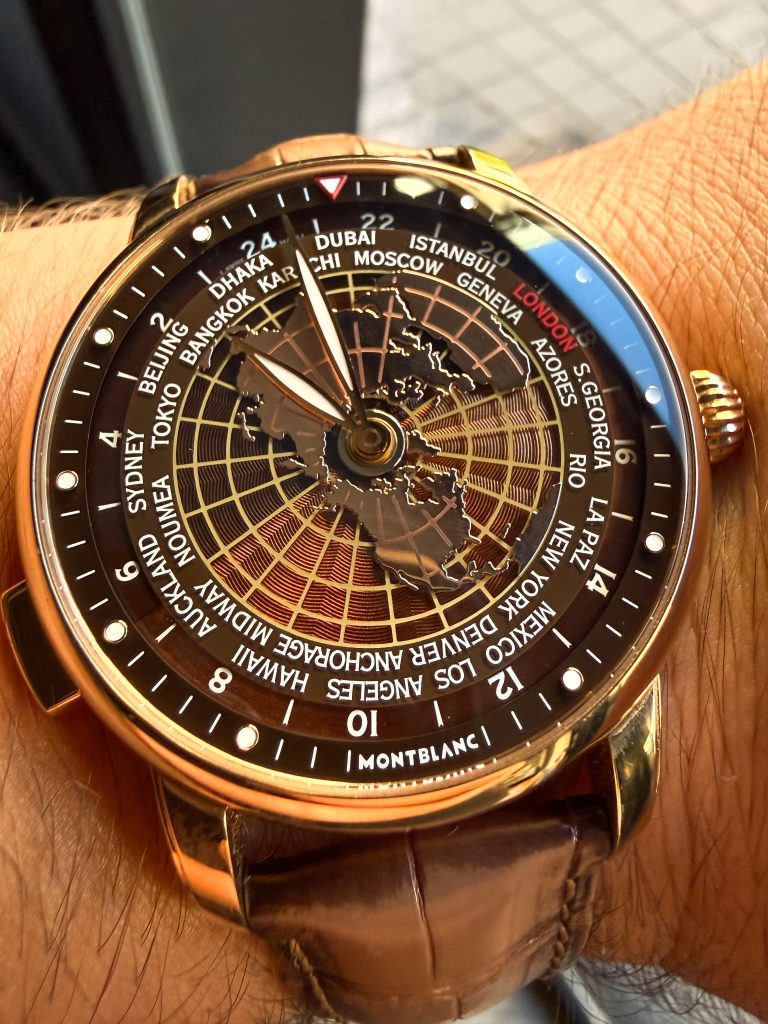
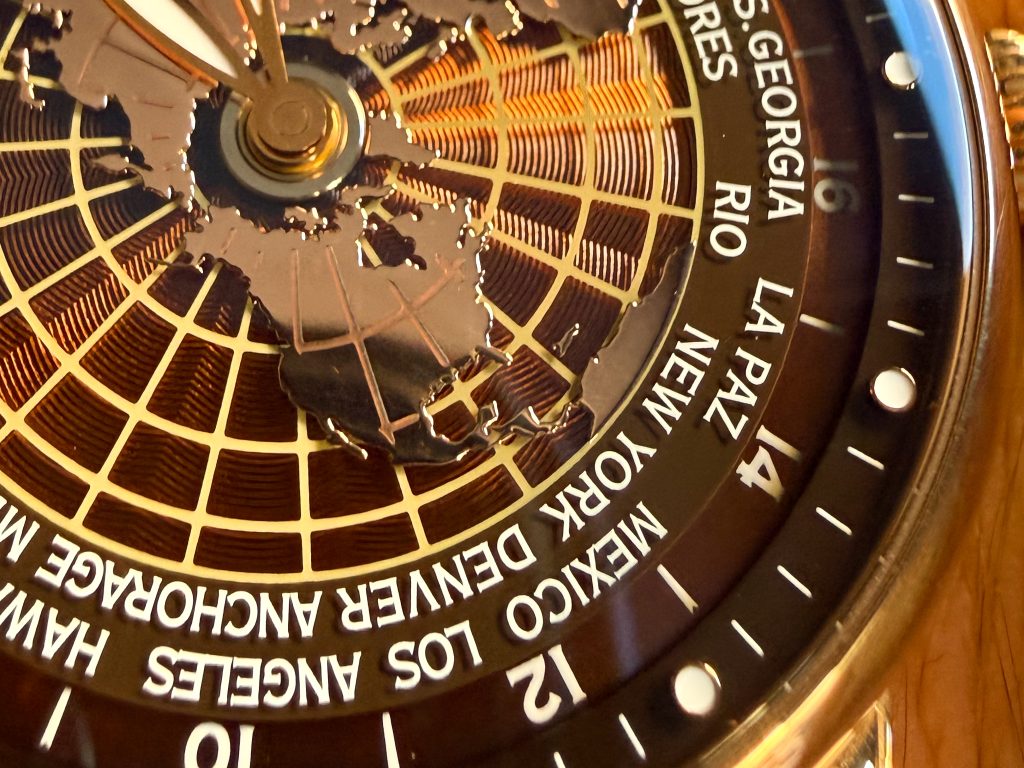
Rather than presenting world time through a conventional ring of cities alone, Montblanc creates a layered, almost three-dimensional representation of the globe. A rotating sapphire-crystal disc carries an applied map of the Northern Hemisphere, complete with meridian lines and a surrounding ring displaying 24 cities representing the world’s time zones.
The effect is striking.
The continents appear to float above the dial, while the transparent sapphire allows the mechanism and the lower disc to remain visible beneath them. On the limited-edition rose-gold version, the warm tones of the case and brown dial give the geographical display a particularly rich, almost antique character.
It is a world map, but one constructed through the language of mechanical watchmaking.
Day and Night Across the Globe
The Orbis Terrarium doesn’t merely tell you the time in different cities. It also provides an intuitive indication of whether those locations are experiencing day or night.
Beneath the sapphire map sits a rotating day/night disc. Over the course of 24 hours, its appearance changes between lighter and darker shades of brown, allowing the wearer to understand the approximate position of daylight around the world.
At 12 o’clock, a red indicator points toward the city corresponding to the wearer’s local time zone.
The result is remarkably visual. Instead of reading a collection of small numbers, the wearer can look down and immediately see a miniature representation of the world and its changing relationship with daylight.
A Case in Solid 18K Rose Gold
The limited edition is distinguished from the regular steel version by its 18-karat rose-gold case.
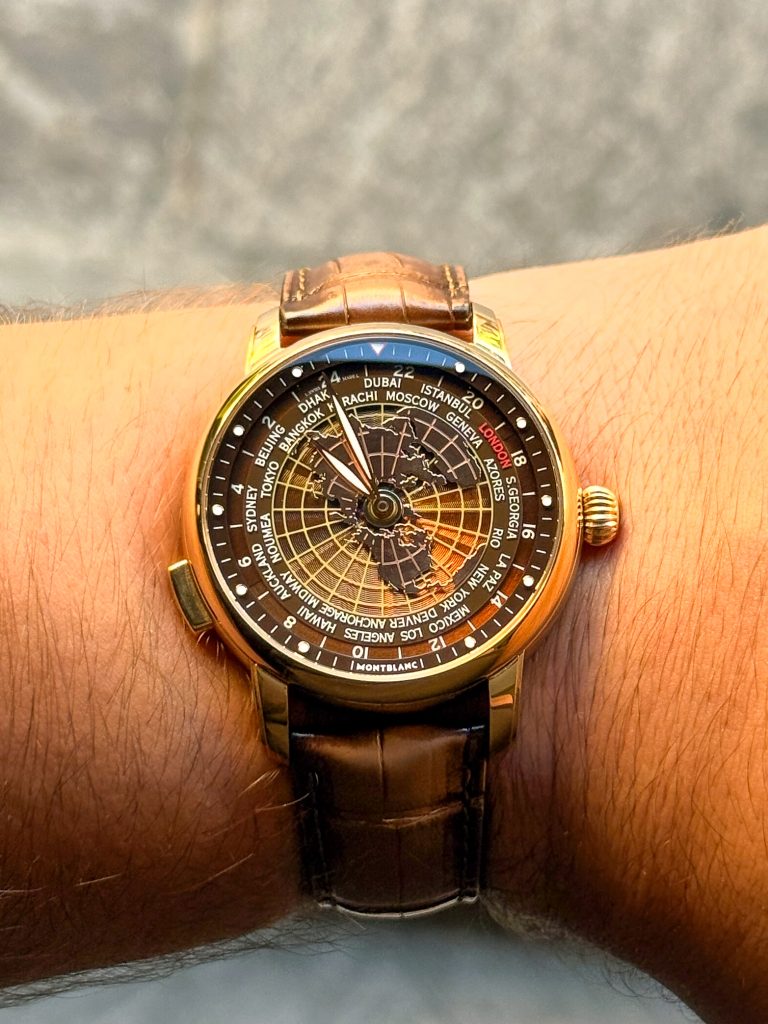
Measuring 43 mm in diameter and 13.84 mm thick, the case has polished surfaces contrasted with satin finishing along the sides. Its rounded form follows the aesthetic language of Montblanc’s Star Legacy collection, while the prominent onion-shaped crown adds a traditional watchmaking touch.
The choice of rose gold is particularly effective here.
The warm metal echoes the brown tones of the dial, the rose-gold-coated continents and the brown Sfumato alligator strap. Rather than treating the precious metal simply as a symbol of luxury, Montblanc uses it as part of the watch’s visual composition.
Everything appears deliberately coordinated.
The MB 29.20
Inside the Orbis Terrarium is the MB 29.20 automatic calibre, combining conventional timekeeping with Montblanc’s world-time complication.
The movement operates at 28,800 vibrations per hour, uses 26 jewels and provides approximately 42 hours of power reserve. Its functions include hours, minutes, world time and the day/night indication.
The world-time mechanism is particularly important to the identity of the watch. Montblanc designed the system so that the wearer can adjust the world-time display through a single pusher, making the complication practical rather than purely decorative.
That simplicity is significant. World-time watches can sometimes become visually complicated to operate, but the Orbis Terrarium attempts to make its considerable amount of information intuitive.
The Beauty of the Sapphire Map
Perhaps the most compelling detail is the use of sapphire crystal as part of the display itself.
The upper disc isn’t simply a protective crystal covering the dial. It becomes part of the watch’s complication, carrying the three-dimensional representation of the Northern Hemisphere and rotating as part of the world-time system.
The transparent material creates depth between the map, the cities and the day/night disc beneath it.
From certain angles, the watch almost resembles a miniature mechanical planetarium.
This is where the Orbis Terrarium distinguishes itself aesthetically. Its appeal isn’t based solely on precious metal or limited production. The watch has an identifiable visual language that makes it immediately recognizable.
A Nod to Minerva
The Orbis Terrarium sits within Montblanc’s Star Legacy collection, a family inspired by the company’s Minerva heritage and the pocket watches produced during the late 19th and early 20th centuries.
That historical connection helps explain the watch’s combination of classical proportions, rounded case architecture and traditional crown design.
Yet the Orbis Terrarium is not a simple exercise in nostalgia.
Its world-time display is decidedly modern in concept. The ability to see 24 time zones and the corresponding day/night conditions at a glance makes the watch particularly relevant to international travel.
The result is a dialogue between old-world watchmaking and the modern world.
Only 500 Examples
Perhaps the most significant aspect of this particular version is its rarity.
Montblanc produced the rose-gold Orbis Terrarium as a limited edition of 500 pieces.
That number places it in an interesting position. It is rare enough to have a clear limited-edition identity, while remaining considerably more available than Montblanc’s ultra-low-production haute horlogerie pieces.
Each example combines the same core ingredients: the 43 mm 18K rose-gold case, brown world-time dial, sapphire Northern Hemisphere map, day/night indication and automatic MB 29.20 movement.
The limitation therefore reinforces the character of the watch rather than being its only selling point.
The Language of Travel
A world-time watch has always carried a certain romantic idea with it.
It suggests airports, international cities, long-distance journeys and the ability to remain connected with home while somewhere else in the world.
The Orbis Terrarium makes that idea visible.
London, New York, Tokyo and the other cities represented around the dial aren’t merely labels. Together they form a map of human activity across the planet, while the rotating day/night disc provides a constant reminder that time is experienced differently depending on where you stand.
In that sense, the watch is more than a technical world timer.
It is a mechanical interpretation of global travel.
A Watch With a Point of View
The Montblanc Star Legacy Orbis Terrarium Limited Edition is not a conventional dress watch, nor is it a conventional sports watch. Its personality comes from the complication itself.
The 43 mm rose-gold case gives it presence. The brown and rose-gold palette gives it warmth. The sapphire globe gives it depth. And the world-time mechanism gives the design a genuine purpose.
Most importantly, the watch doesn’t hide its complexity.
The map is the dial.
The movement is part of the story.
The changing day and night display is part of the visual experience.
Everything revolves around the central idea of the Earth and the passage of time across it.
Conclusion
The Montblanc Star Legacy Orbis Terrarium Limited Edition of 500 pieces is one of Montblanc’s more distinctive interpretations of the world-time complication.
Crafted in 18K rose gold, measuring 43 mm and built around the MB 29.20 automatic calibre, it combines traditional case design with an unusually expressive multi-layered dial. Its sapphire Northern Hemisphere map, 24-city world-time display and rotating day/night indication transform the watch into something resembling a miniature mechanical globe.
But perhaps the most compelling aspect is the way all of these elements work together.
The watch doesn’t simply tell you what time it is.
It shows you where you are in the world.
And with only 500 examples created, the rose-gold Orbis Terrarium remains a particularly distinctive chapter in Montblanc’s continuing exploration of travel, geography and mechanical watchmaking.